Anamorphic

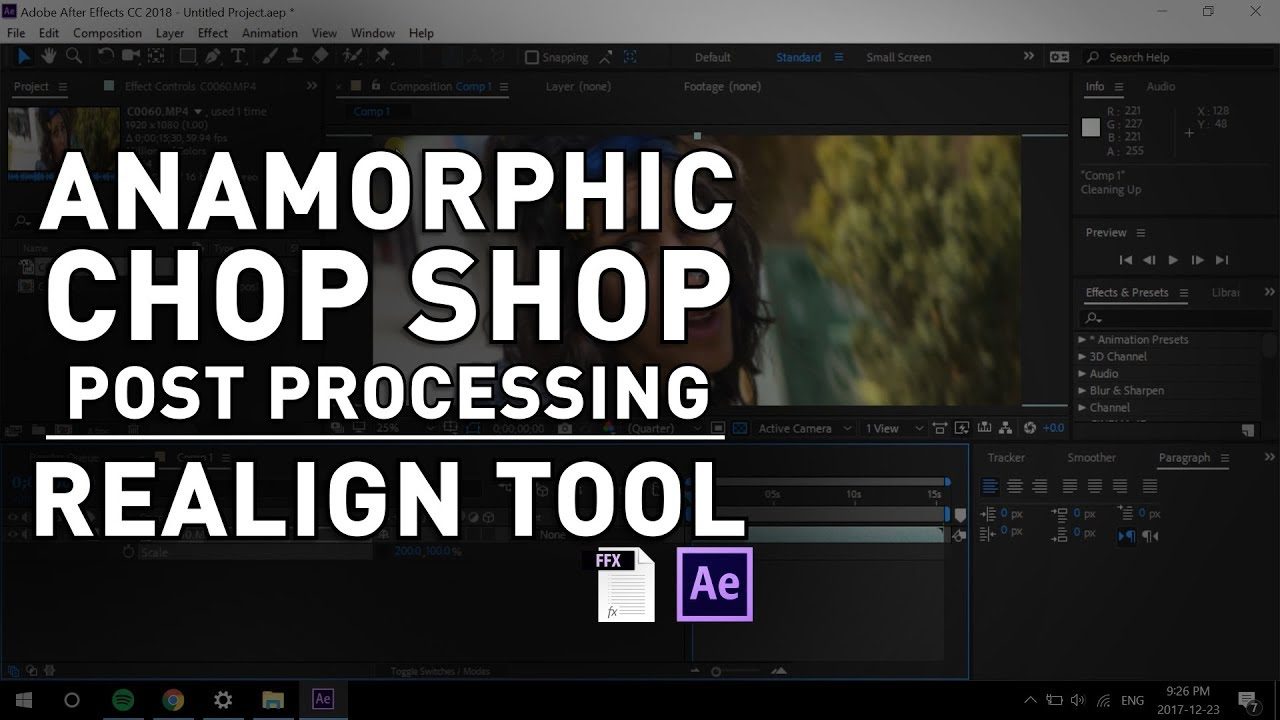
Anamorphic ReAlign Preset for After Effects

December 24, 2017

The Anamorphic ReAlign Preset works with After Effects. Rigged up to improve lens misalignment, just download and start adjusting alignment issues.

USEFUL LINKS:

Place the Preset in the right folder!

WINDOWS: C:/Program Files/Adobe/After Effects /Support Files/Plug-ins or /Presets
OSX: Applications/Adobe After Effects /Plugins or /Presets

This work is licensed under a Creative Commons Attribution-ShareAlike 4.0 International License.
Day-to-Day

Not THE Director.

December 15, 2017

Every time I mention I don't really want to be THE Director, people start losing their minds. "BUT WHY NOT?! Don't you wanna be the boss?"

That's exactly the point. There's no desire deep inside of me to be the boss of anyone. As I mentioned on my Mentors post, I have a problem with authority and it would be hypocritical of me to want to tell others what to do.

The Director persona

Let's see if we're on the same page: when you think of the director's role in the making of a film, what comes to mind? Is the director a genius who comes up with every single great idea you see on the screen; a person that single-handedly runs the film and has answers for every question during pre-production, production and post? Is the director a star? Do you fear them, or are you honored being in their presence? I think you can see where I'm going. When portrayed this way, it's easy to notice how many expectations exist surround the figure of the director.

It makes me wonder why we encourage this archetype of director. While in film school I learned the director is "The King of the Film". All the kids eager to sit on that throne. The word "king" to me sounds more like a tyrant than a fair ruler. Being told you're the "king" and you have limitless power is more likely to bring out your best or your worst? Historically speaking, it's been the worst. Tyrannical regimes benefit a select few while the majority labors away. And we learn this is the way things work.

Leader vs Boss

I don't believe this is the way things should go. I believe this is how things have been so far: the Director is the Man in Charge. This is why I didn't want to be a Director. I don't wanna be telling everyone else what to do, I don't wanna give orders, I don't want to impose my way of thinking onto others. I don't want the glory or the fame, I just want to make movies and movies are not made by one person. Groups of people make them. Large groups of people.

Groups don't need bosses, they need leaders. People that inspire each other to go further, to think harder, to be more creative. People that won't punish each other when things go wrong, but will share the blame, people that are more comfortable putting themselves at risk than putting others. I dream of a film set where impossible things come true and nobody gets hurt in the process; that the cast and crew will go home after shooting and think "that was an awesome day and I'm happy to be here again tomorrow".

Learned arrogance

At Langara, I went into the directing stream. On the second semester my displeasure with what was expected of a director was at new heights. I just didn't want to be that person. Being told I "had to" only made me more disappointed. It got to a point when I scheduled a meeting with Sara, our Advanced Directing instructor, to openly tell her about my directing crisis. What I heard from her played a big part on how I faced directing after the meeting and motivated me to write this post, months later, while continue to pursue being a director.

Collaboration is key. There's simply no way one person has all the good ideas. As directors we need to be open to listening to our department heads, just like they must be open to listening to the folks under them. During the pre-production meetings for "Up & Away" there were plenty of questions I didn't have an answer to, and each of those was a different problem.

Acknowledging I didn't have a solution made more people rally up to fix the problems and work it out together. "Directing is asking questions" is a common sentence to hear when it comes to working with actors. For me it turned out asking questions has been the solution on every front. "How can we get this many people?". "Can we really light flares under a covered area?". "Do you feel safe building this structure?". And, most of all, "can you guys give me a hand with this?".

Ask questions and share the load

Asking questions makes the people around us think and ask other questions in return. It makes us all listen. Listening to our team and trusting their judgement will get the set running on its own. Also, how could we not trust our team, right? We picked them personally! Listening and thinking are underrated traits these days. There's an urge for knowing all the answers from the get-go. There's shame for asking questions in fear they are stupid. And there's an unhealthy eagerness about being told what to do. It empties us from responsibility. If it goes wrong, "it was so-and-so that told me to do it". It's scary to be responsible for something because suddenly you have to care about it.

There are many advantages to this shared-responsibility style of directing but I'll only mention one: when things go wrong - and they will -, instead of everyone looking up at us, "THE Directors", to give them a solution, they'll start solving the problem themselves because they know we trust them. The problem is this is still a very distant dream. I can count in one hand the number of sets I've been that people worked like this.

One of the obstacles in the way of a mindset change is education itself. Lots of aspiring directors want to be stars. They want to be the next Tarantino or Scorcese. They want to call the shots and school says "this is what you're gonna be when you come here!". Learning institutions should focus more on the process than the result, as hard as that might be.

Real world directing

Outside of school, it's our job to not take all the credit if a film goes well. It fills me with joy when I tell people I didn't have a clue of how we were doing certain scenes in "Up & Away" and my co-producers came up with brilliant solutions. Or when the sun was dipping behind a building and our gaffer saved the shot finding us some stray sunlight. Unfortunately you didn't get to see the smile on everyone's faces on set for these spontaneous efforts. These efforts that elevate the quality of the film. I saw them though. It's a collective high and it outshines being the head of the project. If we make films people are happy to work on, I believe other people will be happy watching them too.

It was only after we finished and delivered "Up & Away", after I got feedback from multiple people on the team about how production went, and after a few more long conversations with Sara I figured I want to be a director because I like working towards dreams. Don't you?

Anamorphic

Vistascope 8mm Anamorphic Lens

December 10, 2017

The Vistascope 8mm is a different anamorphic lens. It doesn't use cylindrical glass, but prisms to achieve compression. This leads to some aesthetic differences and an interesting drop in prices. Being a baby anamorphic, portability is a key feature in this one.

USEFUL LINKS:

Day-to-Day

Work in Film - there's so much to change!

November 27, 2017

If you have ever worked for free, this might be of your interest. I've lived and breathed film long enough to learn how to tell bullshit from honesty. We all know there's bullshit everywhere. The reason we all know is because we come up with our own crap, all the time. If you don't think so, better stop now - either stop with the bullshit or stop reading this post.

We all once had someone coming up and saying "this is gonna be a great opportunity in your career". Or "this will look great in your portfolio", or "there's gonna be others after this one". These are all versions of something I'm gonna call "the deal of a lifetime". By promising you the future, your employer convinces you the present is no big deal. We're all poor right now, aren't we? It feels good to dream of a plentiful future while we toil away. I've been there, I've done that. We take pride in the stories of the money we're owed (and unlikely to be ever paid). That's our elusive future, the one we're promised and never delivered.

Work in film is exploitative

We do things we hate hoping for a big reward. The hope is these sacrifices are gonna pay out one day. We want this future to be true. This combined with the stories of success that populate our surroundings is what perpetuates the cycle. EVERY film school tells stories of underdogs who rose to fame and fortune, of nobodies that turned millionaires overnight.

"Film is an inclusive industry" you'll hear over and over. The film industry is the American Dream that failed to die. Actually, that's not true. The film industry is the failed American Dream that has enough money to disguise its shortcomings and repeated failures. It's cheaper for the business to spend money advertising that all is well and continue to siphon dreamers like us, underpaid and overworked, than to admit its flaws and reward people properly. Later on, this environment will allow you to exploit someone else. In the same way someone exploited you throughout your career.

We're taught our time is not worth much.

As I went through film school again, I was less dreamy. I struggled trying to understand why our environment is so based on the concept of "you trying to sell how YOUR project is important to ME while I know full well that you don't really mean what you say"; I know you're the one getting the better deal; In your head my role can be replaced while yours can't; In the end when reward comes you're the one reaping it while I watch from the distance. I don't understand if I pretend to believe you as a way of justifying my poor choice or, if after being hammered over and over that this "is good for my career", I actually believe it might be my big break.

It has taken me ten years of no big breaks to figure out some things for myself when it comes to work: Deals of a lifetime don't come dressed as deals of a lifetime. It drives me crazy whenever someone tries to sell me their project as such deal for my career. I'll know it when the time comes - IF it ever comes. I'm not too eager for the deal of a lifetime and this is why I prefer the honest take on work.

If you want my services for little money be upfront about it. Then let me decide if I want to join the team or not. Don't try to convince me with some bullshit reason because we all know it's a lie. Make sacrifices too. The last two sets I worked on my superiors were getting less money than me. They expected something other than a paycheck from it and that made me respect them tenfold.

The toxic culture of work in film.

I see a film set as a tiny functioning society. I don't feel like putting my chips on a society that is the same or worse than the one we have on our daily lives. By that I mean a society in which there's the top dog who eats steak for lunch and gets paid by the minute while some kid stays up for fifteen hours in the rain so they can get minimum wage. I believe hierarchy is necessary on a film set. I know some jobs are more stressful or require more prep than others. Yet I don't believe in the current wage gap. The system as it is favors the type of competition in which people sabotage each other. People also don't own up to their mistakes because they're afraid of being fired or, even worse, blacklisted.

It's time we change the film industry

There's a culture of putting your head down and trusting the system that your time will come. This only perpetuates the issues we have now. The unraveling we witness today is a consequence of empowering people who were silenced in the past. These aren't new problems. They're entrenched in our industry, remnants of a period based on inequality. Keeping your head down doesn't encourage discussion or change. Discussion and change are the future, and much needed in the film industry.

I love film and I don't want to change the magic that shrouds it. I am changing my approach to making films though, and so should you if want a better working environment for the years to come. When we're the ones making the rules, let's not repeat what we were told and what we went through. Let's question it; Question how things can be improved and made better for everyone involved. Let's bring to set the same magic we experience when watching a good film because, let's face it, we spend way more time making films than watching them.

Day-to-Day

Mentors - real people that inspire me

November 22, 2017

This year I went to film school. Again. This is the third time I'm doing it. Each one of them was very different due to my approach and focus. There is a common aspect to all three. I met amazing people. They taught and inspired me to improve my craft. Not to mention to become a better person overall.

These people challenged the status quo and questioned what was expected of the students. They were open to unusual lines of thinking and an incredibly questioning student (the one writing this) with authority issues. I'm not gonna say there were lots of these people everywhere. There was one or two of them for each time.

University of São Paulo

My first mentor was Fernando Scavone. He encouraged me to write a graduation paper unlike any that came before. A blend between theory and practice that was gonna turn into template for future classes and projects. I didn't know that at the time. I also had Luli Radfahrer. He has a unique view on how to teach basic photography. This made me rethink how I went about the subject. He let me teach one of his classes to see if I could prove a point we disagreed on!

Vancouver Film School

My savior and mentor the second time was Werner ten Hoeve. To this day, I still don't know exactly why we bonded so well. I was going through the hardest time of my life. Yet I kept my no-bullshit attitude of not taking orders without question. I wouldn't accept that some things are just "meant to be". I think Werner liked me because I owned my final project and never complained about the challenges he gave me.

Langara College

The third and hopefully last (at least for a while) time, at Langara College, I had Janin Palahicky, the key instructor when it came to dealing with gear and technical questions. I honestly don't know how he put up with me since the beginning of the program while I questioned the cameras we used, the lenses we had, the software used and other basic level instructions. Nowadays we have a group chat and talk about both work and mundane things.

The other important person at Langara was Sara McIntyre. When I went into the film program, I went for cinematography. Cinematography was a part of the directing stream which involved, among other things, directing a couple of short films. I never wanted to be a director. We'll get to that in another post. I believed I didn't have the traits required to be a director.

After a semester of Sara's Advanced Directing classes my resolve in not to be a director was a little shaken. She is a director. Her views on everything a director represents went the opposite way of the director archetype in my mind. In multiple occasions I came to Sara with this subject and we discussed what it meant to be a director. She changed my view on the film industry. I went from simply accepting what's already there into fighting for what you think is right. There's plenty of things in the film industry that need to be made right.

Not all mentors are teachers

Weaving through this process, from all the way back at University of Sao Paulo to the present days, there's Bruno Nicko. We made a webseries together, we lived together more than once, and whenever I decide to learn something new, he's there to support me - many times by teaching me. The same way Nicko comes aboard for my crazy ideas, I always jump in to help and encourage him on his. Among the shared qualities: our bikes are identical - he got his first; we started riding fixed gear together and we don't really like big crowds of people or social events. Sometimes we don't see each other for quite a while but every time we chat, it inspires me to grow and see things under a different light.

After this last time in film school - and two years of weekly therapy sessions - I found some connections between all the people mentioned above. They didn't try to stop me from doing something simply because it had never been done before. They are the ones that instead of fighting back against my questions, were open to listening and talking about said questions. The point was not "who was right and who was wrong", but the conversation itself. The outcome was not as important as the process. They were the ones that didn't simply accept things that "are". They saw potential for change, for doing things differently.

These folks are my compasses and I'm extremely lucky they're just a phone call or email away.

Day-to-Day

Home: Getting Permanent Residence Status in Canada.

November 21, 2017

As I crossed into the US yesterday, the border agent asked me where I was headed.

- São Paulo, Brazil.
- Is that home for you?
- Yeah.
- And what were you doing in Canada?
- I live here. I just got Permanent Residence
- So Canada is home?
- Yeah, I guess.

He didn't question me further and wished me a good trip.

For four hours I slept. The first part of my 6800 mile journey was a flight to Dallas, then a 6h wait, and a 10h flight to Sao Paulo. 6h waiting at an airport is a damn long time even if you have options to keep yourself entertained. 6h feel like forever for me. My mind then conjured a return to my chat with the border agent.

On living alone

Leaving home is a drastic thing. There are several degrees to it. The first time I left home was in 2008. I moved from Salvador to São Paulo to pursue a dream of filmmaking. One day I was home, the next I was 1000 miles away from my parents, my sister and my friends. It took me a while to rewire my brain and get used to it.

Living by yourself, if you want something done you are the only one responsible for getting it done. That can be both positive and negative. Positive as in if you want something, there's no one there to stop you. Negative because there's no one there to give it to you. No one was gonna carry me anywhere or push me forward. It was all up to me.

This was great. I became independent and never minded being by myself. I enjoy my company quite a lot. The problem is after you're on your own for long enough, you end up forgetting you can rely on others. I taught myself photography, visual effects, juggling and filmmaking. Getting this blog up and running in 2008 is a result of living on my own. I also created a YouTube channel with 6000 subscribers and came up with various small passive income sources. On the downside, I never had more than a handful of friends, I've had more than one relationship crumble because of poor communication skills and only recently I started to feel comfortable trusting other people with things that matter to me.

I'm always moving forward

Buying a one-way ticket symbolizes there's no going back. It's not a temporary thing. It's an indefinite amount of time - many times with an indefinite goal in mind. There's no "if I fuck up, next week I'll be home and this will all be forgotten". It's starting from the ground up - not for the first time for many of us. It took me three and a half years of living in Canada before I was legally able to do similar work I used to do when I left Brazil. Don't read me wrong, I don't regret leaving home, but it's important to acknowledge these are three years of my life that I'm not getting back. The only thing I can do is try to fly through the challenges I would've had more time to conquer.

That's my plan for 2018. To make up for the lost time.

I was amazed by how my views changed after getting Permanent Residence status in Canada. I was suddenly no longer afraid, I didn't waste all the time leading up to this point. It amounted to something. I'd get something out of all the money, sweat and tears - there was plenty of all three. Suddenly there was a future I could plan for, and no longer an if-statement. I started caring about where I lived. I cared about the people around me, about recycling and about making life better for others that are facing similar struggles to the one I withstood.

What/where is home then?

I'm proud of being Brazilian and I've always perceived my background as enriching and inspiring. The difference is now I feel like a Brazilian that belongs in Canada and not like a Brazilian who's only here for a certain amount of time. I still feel like a foreigner but not anymore like an outsider.

Home is wherever you feel comfortable at, is the place you care the most about, is where you feel you're welcome to be yourself with no masks. At the time of writing this post, I have three homes, and each of them harbors very very special people I can't imagine living without.