Anamorphic

Anamorphic Cookbook - hFOV Calculator

February 13, 2016

UPDATE - DECEMBER 2016: I updated the calculator! Click here to check the new one. It is more accurate and complete than the original version.
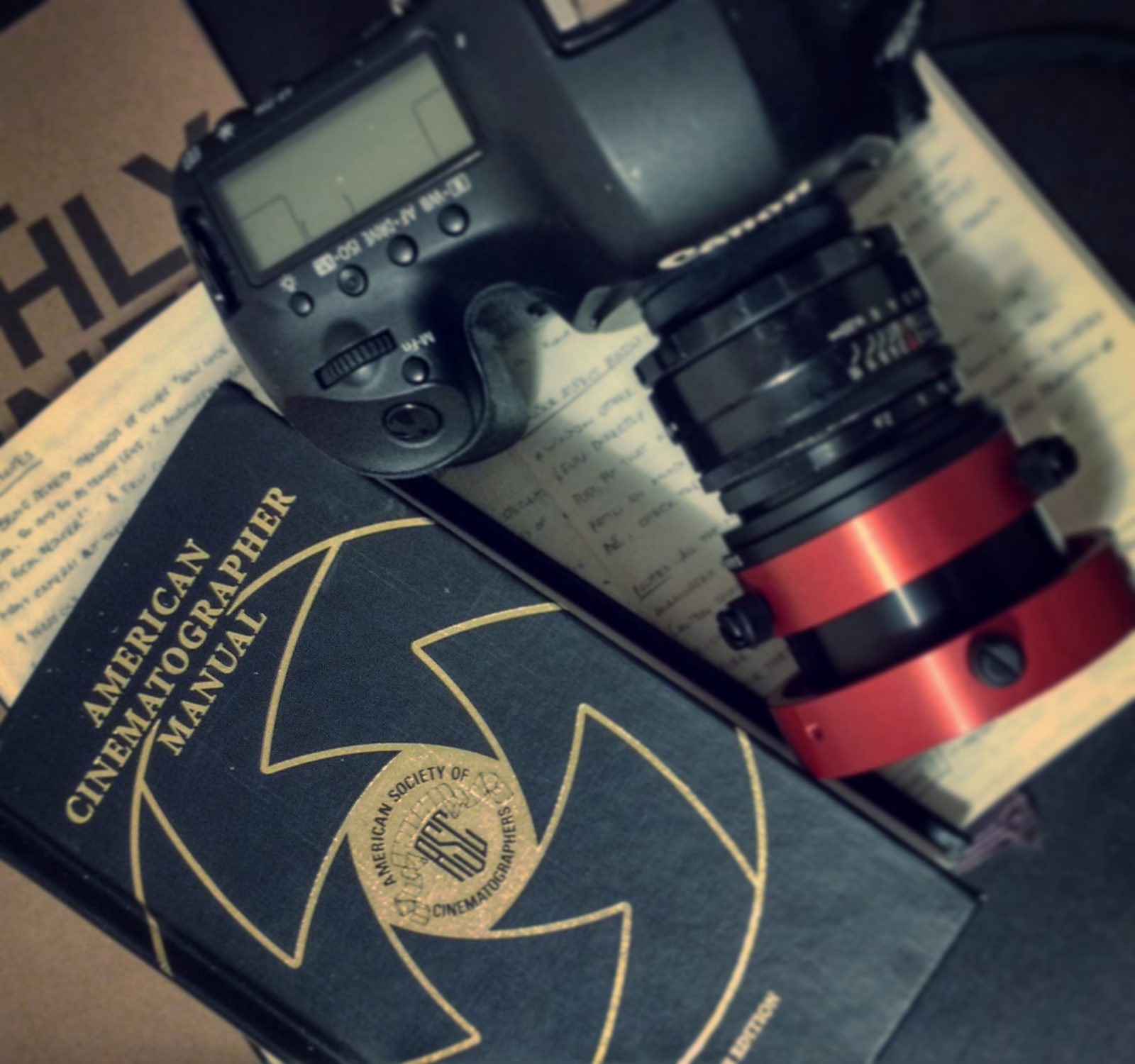
After being asked thousands of times "how wide can I go using this camera, so and so as taking lens, X anamorphic and, oh, I'm also using this chinese focal reducer!". A few comments on that: there are way too many cameras out there. I use a 5D3, a camera that's already four years old - so I'm not too into what's trending now - and has a full frame sensor. The main reason I chose full frame is because I hate crop factors; I hate doing that math. I haven't used other cameras since I got the 5D3; I don't know - and I don't WANT TO know - all the specifics for all cameras available at all times in the market. Gladly, they can be grouped in categories based around crop factors and sensor size.

With a little bit of research, many hours of coding (and a super helpful plugin) I came up with this calculator. It should answer most questions about vignetting and horizontal field of view (hFOV) while using anamorphic lenses. All settings are picked from the dropdown menus, except the taking lens, where you can input whatever weird glass you like. Of course, you can override any of them with your own custom values. Below are a few notes about each setting. Enjoy.

CAMERA: The standard crop factors are here. If you don't know your camera's sensor size or crop factor, Google "NAME_OF_YOUR_CAMERA_HERE crop factor" and you'll know what to pick from the list. If you're recording with a different crop, check the "custom" checkbox and input your crop factor manually. Blackmagic instated chaos and every single one of their cameras has a different crop. I've included the URSA (because of its anamorphic mode) and the Pocket Cinema Camera (because of its popularity) on the list, but if you're using something else, input it manually.

FOCAL REDUCER: RJ Focal Reducer and Vizelex's Light Cannon are filed under "Others". Metabones's SpeedBooster is 0.71x. The numbers of focal reducers are also growing, so if you can't find yours in the list, select "custom" and input the number.

TAKING LENS: Write here whatever's listed as your focal length. If you don't know your lens, sorry, I can't help you! If you wanna know which taking lens will give you a specific hFOV, tick the "I want a taking lens" box and input a focal length in the Resulting hFOV field that shows up.

ANAMORPHIC: I wanted to add the names of the lenses here but the dropdown would be endless and there would be a lot more detail to this calculator. Maybe in the future. For the time being, just pick your stretch factor from the list. If you're unsure about your stretch factor, google it. I added two variations for the 2x and 1.33x scopes, since they change the math of vignetting a little bit and were worth the modifications. Thanks to all the people who came up to me and pointed this out.

SENSOR ASPECT RATIO: More and more people are shooting with a window other than the default 16:9 This affects vignetting and hFOV directly. If you're shooting 16:9 and cropping the sides in post, put that ratio here too, since it works the same way. If you have a specific odd final aspect ratio in mind and want to know how your sensor aspect ratio (AR) or settings should be, check the "Tell me my Crop" option and let the calculator know your desired Resulting Aspect Ratio in the field that shows up.

NOTES: All the math revolves around the 1920x1080 proportion. The GH4 anamorphic mode acts a little different as well as Canon with Magic Lantern shooting raw because both cases allow you to change the recorded height (pick these options at the Sensor Aspect Ratio menu). If you're shooting at different resolutions, adjust your numbers accordingly to match the 1920x1080 proportion before input here or accept the slight differences you might get from not doing so.

Also, if you're interested in more anamorphic content, check the overall ideas for the Cookbook and the already available for free "Anamorphic on a Budget" Guide!

DISCLAIMER! This is not a scientific tool, it's designed to get you in the ballpark of which anamorphic goes with each taking lens. There are a few exceptions to the rules shown here and you should do some extra research on your specific anamorphic. Baby Anamorphics (Möller 8/19/1.5x, Baby Hypergonar, Iscomorphot 8/1.5x) are a notable exception to the presented by the calculator and vignette more easily on larger sensors, but they play along fine with smaller taking lenses and sensors. Also, about the GH4, there are some weird situations in which its behavior doesn't match the math, so be careful and do some more research on your own.

DISCLAIMER 2! I'm officially not replying anymore to questions about "how wide can I go with this anamorphic". If you wanna know, check the calculator and do your individual research. Post in public places, facebook and EOSHD are great places to start. I might even show up to reply, but there are plenty of people with much more experience than me willing to help beginners and people with questions.

DISCLAIMER 3! I know the calculator could have a lot more intricate fields, more cameras, more lenses, but this is as far as I'm going with it right now. If you wanna work on an advanced version, be my guest. If you want me to repost it, I'd be honored.

UPDATE - DECEMBER 2016: I updated the calculator! Click here to check the new one. It is more accurate and complete than the original version.
Day-to-Day

A brief commentary on Zhang Yimou’s “Movie Night”

February 3, 2016


In “Movie Night”, Zhang Yimou plays with the idea of a village coming together around cinema, which works both as a metaphor about the Chinese film industry as well as speaks to the experience of going to the movies. It is his way of showing that cinema is a very special art form which can bring people together in times of hardship. In Zhang’s short film the movie going experience is special to anyone who sits in front of a screen surrounded by others; going to movies is a collective experience. “Movie Night” feels like a love letter to the medium which he dedicated his life and work.

Zhang Yimou is one of the key elements in what is called the Fifth Generation of Chinese filmmakers. The Fifth Generation - a part of the overall artistic resurgence that grew after Mao Zedong’s government – is composed by many of the first graduates from Beijing Film Academy at the end of the Cultural Revolution (a socialist dictatorial regime that ensnared China from 1966 to 1976). “Fifth Generation films are characterized by their emphasis on cinematic qualities, unlike traditional Chinese cinema which attaches prime importance to plot, melodrama and literary adaptations. . . . [M]elodrama is rejected in favour of formal innovation and experimentation” (Ng). These changes in form quickly launched China among overseas audiences and pleased the domestic public with titles such as Yellow Earth and One and Eight - Zhang worked as the cinematographer in both films (Farquar).

Zhang is not only a director, but also a producer, former cinematographer, actor and writer, winning awards or honors for all of these positions. This wide range of knowledge over every aspect of movie making is not an essential quality for directors, but provides them with useful tools: the directors that understand every aspect of the process of making a movie are able to achieve outstanding results because they translate their vision easier to each department's own language as well as understand and address their concerns. Zhang Yimou’s films have a special quality about them: there’s nothing out of place; every little thing has been meticulously planned and executed.

Graduating from Beijing Film Academy in 1982, his career as a director would only start in 1987 with the release of Red Sorghum, which uses of strong colors and beautifully presents a mundane story (opposed by the military epics of the Cultural Revolution) regarding a small village and one of its inhabitants (a girl who worked at a sorghum distillery). Zhang Yimou breaks the paradigm of what viewers expect of Chinese movies, falling into the graces of art film critics and broader audiences. This film granted him the Best Picture award at Berlin’s International Film Festival in 1988. In 1989 he released Ju Dou, shot in the outdated Technicolor process, which yields incredibly vivid and saturated colors. This movie also takes place in rural areas and tells a story of ordinary people, common themes in Zhang’s career. Ju Dou became the first ever Chinese movie to be nominated for the Oscar of Best Foreign Language Film.

Besides the ordinary aspect of the stories – all very personal and character focused -, one of the strongest characteristics in Zhang Yimou’s work is the visual finesse. He presents this in his movies through the use of colors – both intense and saturated, adding depth to the stories. His second nomination for the the Oscar of Best Foreign Language Film was for Raise the Red Lantern in 1992. Desson Howe, a film critic for the Washington Post, wrote:

There isn't an arbitrary hue in the movie. In purely aesthetic terms, ‘Raise the Red Lantern’ is breathtaking.. . . Whether color -- and other aesthetics -- can carry an entire picture has been raised before in connection with Zhang's work . . .. In "Lantern" he comes close to pulling it off. Passion for the spectrum (particularly the redder end) suffuses . . .  this tale of a power struggle in 1920s China. Chief among things vermilion are the titular lanterns. In this movie, they represent the pinnacle of power. (WW50)

Colors are symbols, standing for different aspects of the universe and characters, transmitting raw emotion and meaning without ever being directly explained in the movie itself.

“Movie Night” is a 2007 three-minute short film Zhang Yimou directed for the Cannes Festival DVD anthology To Each His Own Cinema. It is interesting to observe that some of his trademark features can be noticed in just over three minutes. This short film leads us through the arrival of the projection crew in a small village.

The film starts with a close up of a young boy’s face, it is safe to say he is the protagonist of this short film. We then hear a truck approaching and the boy runs towards it, joining a much larger group of kids that are already following the truck. We are introduced to one of the projectionists in a close up and then have another of his romantic counter-part. As they enter the village, the number of people running after the truck increases and their average age does the same. Every step of the setup amazes the little boy and other kids – they jump after the screen, he is startled by the speakers turning on and watches carefully while the men load film rolls into the projector. At this point the entire village is hovering around the area, perched on ledges, benches and chairs they brought from their own humble homes.

There is a gorgeous moment when we cut from the large audience to a wide shot of the village and see the Sun setting behind one of the houses. Then Zhang cuts back to a wider view of those people gathered around the screen. It seems the entire population of the village is there, waiting for the dark so the movie can begin.  Then the sun finally sets. The sound reinforces the strength of the night by quickly muting all the insects and birds we could hear in the background during the day and bringing in full, undisturbed, silence.

When the projector turns on, it is like a party. Everybody laughs and celebrates while throwing their hands up in the air and casting shadows on the screen. Right before the movie starts there is a very interesting scene in which the projectionists have dinner inside their tent with the light on. That is the only light source at that point, so their shadows are cast perfectly on the tent’s walls, a direct link to Zhang’s own To Live. It is a beautiful reference to the country’s original culture of telling stories before cinema, and everyone in the village watches those men’s shadows like they are actors in a play.

The movie finally starts and by then the little boy is too tired (or bored) to watch it. The magic is not exactly in watching a movie, but everything that surrounds that experience, the people gathering together, the waiting and expectation, staying in the dark. It is Zhang Yimou’s way of saying that, in moviemaking, the craft is more important and exciting than the end result.

From his traditional elements, it is easy to notice the mundane story, humble characters and the setting in rural China. The people coming together towards a common goal, unaffected by the challenges they have to face – though in this case, there are no life or death challenges. The camera work and compositions are all well thought out even though we lack his strong color schemes.

“Movie Night” has a more realistic approach to cinema. Instead of telling a fantastic story, like he does in his feature films, Zhang Yimou is trying to convey how it feels to be a Chinese filmmaker. According to Gerald Pratley about the rise of Asian cinema, “In China everything is falling apart yet it manages to hold together, nothing works yet it keeps on going, nothing is ever finished or properly maintained” (Kinema). This decadent yet functional aspect of the country is directly represented as the village and its people in Zhang’s short film as a metaphor for Chinese cinema: their work environtments are not that amazing, but Chinese filmmakers still put on hard work and achieve beautifully looking pictures.


Works cited

“Movie Night”. To Each His Own Cinema. Dir. Zhang Yimou. 2007. Cannes Film Festival, 2007. DVD.

Farquar, Mary. “Great Directors: Zhang Yimou”. Senses of Cinema 20.1 (2002). Web. 02 Feb 2016

Howe, Desson. “Tinted Love: ‘Red Lantern’”. The Washington Post 08 May 1992: WW50. Print.

Ng, Yvonne. “The Irresistible Rise of Asian Cinema 3”. Kinema 2.1 (1994). Web. 03 Feb 2016 

Pratley, Gerald. “The Irresistible Rise of Asian Cinema 1”. Kinema 2.1 (1994). Web. 03 Feb 2016 

Day-to-Day

Langara College and Freelancing.

February 1, 2016

Crap, it's been a while.

I forgot to mention I started a new school. I'm now a student at Langara College, as a part of the Creative Writing program. This is reason enough for some possibly weird posts showing up here more frequently. Not everything I write is about true events. All the anamorphic posts are still safe, though, but I plan to start posting some fiction along with these day-to-day posts and not make an obvious statement to which ones are real and which ones aren't. You've been warned.

Lately I haven't had time to anything but work and school. The upside of an English-focused course is that my writing is bound to get better. The downside is the amount of pages per week I need to go through. Add freelance work for a short film and you got an explosive mix. Spring Break is coming next week and I can't wait for it. I feel like sleeping for three days straight. The whole lens renting thing has been improving, but we still need more visibility. That's another plan for Spring Break.

I've fallen behind on my weekly lens reviews but I'm working on upgrades to sound quality and changing a few things here and there. I haven't abandoned my anamorphic readers though, posting some in-depth articles on variable-strength diopters - there's one on regular diopters that's coming out soon enough. The Anamorphic Cookbook is shaping up, but there's plenty to write and test. To partially fund the project I'll be selling gear soon - anamorphics mainly. I've reached that point that you look at your gear and think "well, this is a bit too much and there's plenty of stuff here that I'll never use". Iscos will go, Century, some Canon glass, probably the 5D3 too (switching to the Sony A7s2 soon, which will get me a larger scope of available glass).

Working on the side of everything else, I've upgraded my notebook - extra hard drives for speed and storage - and replaced the battery which was dead for over six months. If you ever had a dead-battery notebook, you know how annoying that is. The hard drive replacement operation was incredibly convoluted and even though I read a lot on how to mirror them and tested different software, at least twice I thought I had lost my OS and would have to reinstall everything - which was the exact opposite goal of these upgrades. In the end it worked out, but not without some command line incursions to fix tables and partitions while trying to keep Windows intact.

Anyway, I can't stay for too long, gotta get back to my assignments. Talk to you guys soon.

ps - Have I ever said how I dislike these pictureless posts? I'm working on that too.

Anamorphic

Variable-Strength Diopters for Anamorphic Shooting

January 16, 2016

2015 was the year of the variable-strength diopters. They're popularly known as single focus solutions. Yes, I am talking about the Focus Module (FM Lens), Rectilux and Rangefinder. The FM had a good headstart, released to the public in late 2014. The Rectilux and the Rangefinder started shipping almost at the same time, mid 2015. As much as you'd like, this is not the time I'll throw them against each other. This comparison is coming soon. For now this is an in-depth explanation of how they work and why it took so long for them to show up. This is probably the nerdiest and most technical post I've written so far. Hold on to your optics and don't hesitate to ask questions!

Variable-Strength Diopters in History

It all starts with the Iscoramas, back in the late 1960s. Iscoramas were the first anamorphic adapters that could go on any taking lens and not deal with double focus. That is: focusing both lenses - taking lens and anamorphic - at the same distance. Set your taking lens to infinity and use the Iscorama's focus ring. Iscoramas sold already attached to infinity-fixed-focus 50mm lenses. Isco Optics had developed their own way of achieving this result and patented its optical design.

This decision shot Iscoramas' prices through the roof forty years later. You can find a few patents on Google. Here are two for the US and one for Europe (patent one, patent two, patent three). All filed by Isco or Schneider GmbH (the evolution of Isco Optics). The patent prevents other companies from making any lenses that work the same way. This pushed the Russians towards their synchronized focus rings for taking lens and anamorphics. It also deprived the world of any other single focus anamorphic adapters. Genius, from a business standpoint.

Light travels

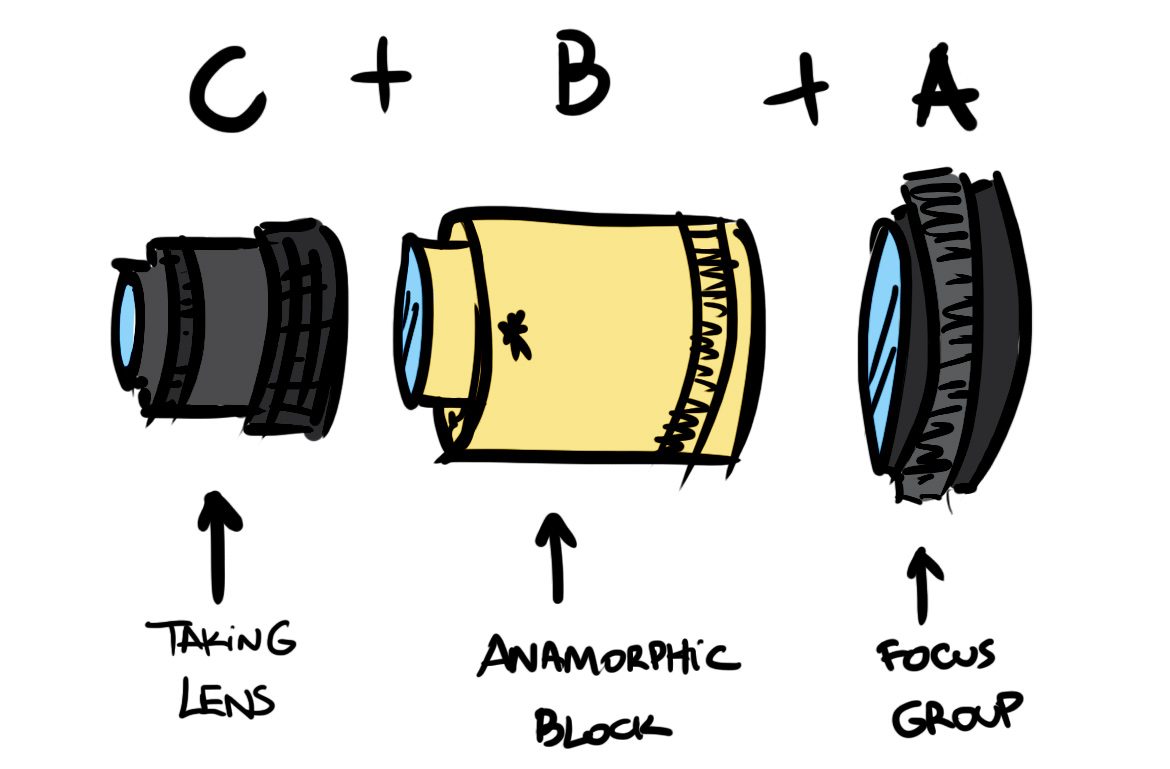
This was an impossible barrier for the longest time. Nobody could make a single focus adapter based on the same principles. Oh, yeah, and what are these principles? Let's consider a three-part optical chain consisting of A + B + C. A is the focus group, B is the anamorphic group and C is the taking lens group. A > B > C is the path light follows from the outside world to the sensor.

Glassworks:

The taking lens, or rearmost optical group (C) sits at infinity. The anamorphic block goes in the middle (B) also set to infinity. A third optical part, the focus group (A) consists of a variable-strength diopter. We all know what diopters are and what they do by now. A variable-strength diopter is a combination of optical elements that acts as a diopter. It does so by changing the maximum focus distance - infinity - to something else. While regular diopters have their power set in stone (or glass, haha), variable-strength diopters range from +0, at infinity, to +1 or +2. These powers drag infinity down to one meter or half a meter!

variable strength diopters light path

So why do the other components of the system have to be focused at infinity? Anamorphic adapters perform best at infinity, with sharper focus and their nominal squeeze factor. Second, if you'd set the variable diopter at the +0, or infinity position the other lenses are expected to see an image at infinity, and the variable-strength diopter will bring "infinity" closer as you change its strength. Plus, this allows you to have distance marks on your single focus solution like the Rangefinder does, that relate directly to the diopter strength that is being used, converted into its maximum focus distance. Before I proceed, I thank John Barlow for this explanation, more than a year ago. I haven't found an easier one to understand out there yet.

Why did we take so long to figure this out?

Now we know how the variable-strength diopter affects the entire system, but what took them so long to get here? My guess would be that everyone kept thinking about making a full single focus anamorphic adapter, and then hitting the patent wall. The moment they disconnected both parts - anamorphic block and variable diopter - the solution was found, since there were no patents preventing anyone to make variable-strength diopters.

The requirements were hard though, since the glass had to be big enough to fit in front of most anamorphic adapters without (too much) vignetting and image quality couldn't afford any hits - which is a serious issue with any other "photographic" variable-strength diopter you can find on eBay, as Jim Chang shows in his post at Rapido Technology's blog - since anamorphics usually mess up your image quality enough. This technical demand is the cause for the high prices - plus R&D expenses!

And what is an Iscorama?

Revealing the trick: an Iscorama is basically a high quality anamorphic block set to infinity fused with variable-strength diopter that ranges from +0 to +0.5 (which limits minimum focus at 2m!). Good thing for us we now have plenty of high quality anamorphic glass available - Isco Cinelux and Blue Stars, Kowa B&H, Hypergonars and so forth -, both modern and vintage, to suit every kind of look.

Whereas the Iscorama is more like an Apple computer (sleek design, light and powerful but you don't have much control over what goes on in the inside), the alternative to them would be PCs, cheaper, bigger, but they allow you to control every aspect of what goes under the hood. You can pick your taking lens, your anamorphic and even choose from a few options of variable-strength diopters. Later, if you wanna tweak it, each of these elements can be replaced and upgraded at your will.

Anamorphic

Anamorphic Cookbook - Intro.

January 15, 2016

This image has an empty alt attribute; its file name is anacooktitle.jpg

HEADS UP! This is an old draft of what I envisioned the Cookbook to be. It changed shape a lot in 2020! Here's the new Cookbook!

This is my second take on a Guide for people interested in anamorphic lenses. My first compilation, the Anamorphic on a Budget guide, was also my graduation work at University of São Paulo (Brazil). It explains most of the basics about the lenses and a little bit of their history, but there's a lot of it dedicated to my final project, Zona SSP. This time I don't have a project in mind. The Anamorphic Cookbook is the result of almost five years of experiments with various lenses, systems and cameras. I'm trying to bring everything I learned during this time into understandable (even though very technical at times) writing for all of those who are entering the anamorphic world or already experienced shooters who want to learn a thing or two about lenses other than the ones they're used to. MOST of it isn't science, but as close to it as I could get through repetition, discussion, analysis and comparison. All of what I write is true for me and if you get different results please don't hesitate and shoot me a message or, even better, leave a comment, so the whole discussion can be public.

What should you expect to find in this book? Actually, before that and even more important, what are you NOT gonna find in this book? For starters, I won't tell you what lens to buy, or what's the best lens for beginners simply because there is no objective answer to these questions. I'll analyze dozens of lenses, give you charts and comparisons tell you which style of shooting works best with this and that lens and it's up to you to decide which one you feel more confident with. All adapters have their drawbacks, some will bother you more than others.

Another thing I'm doing is dedicating a lot more space to talk about taking lenses and their effect on the resulting image. Why do we keep hearing vintage optics work "better" than modern glass, the effects of multicoating, zooms versus primes, why does everyone love the Helios 44, and other questions like these. The order of the chapters might look a bit odd at first but I'm doing it the way I believe people should learn these subjects. For example it's essential to understand diopters before we get to talk about any anamorphic adapters. Diopters are, by far, the most underrated subject when it comes to anamorphic filmmaking and these tiny pieces of glass can boost the character of your production tremendously by directly affecting bokeh and stretch factor, but nobody ever seems to really care about them. It's always "do I need diopters with that?"

Since Anamorphic on a Budget was published there was an increase in the number of cameras featuring anamorphic modes and such, like the GH4, Ursa Mini, Alexa 4:3, and the never forgotten and super convoluted workflow of shooting raw on Canon cameras. Plus, everyone's eyes are always shining and asking manufacturers "Will this firmware update offer an anamorphic mode?" even though I get the feeling that most users don't grasp the advantages of such modes versus simply cropping the sides of a 16:9 frame. This time I'll do my best to try these cameras personally and explain why these or those settings are a way to improve (or simplify) your workflow.

As any film school will teach you, you first got to learn the rules and know them by heart before you start breaking them. Anamorfaking is possible, but if you don't understand how the real thing works, there's a great chance your fake will yell "FAKE!" and bring your production value down instead of up. In this section I'll talk about flares, filters, mods and post processing, all of them cheaper than the real thing, which is what makes them interesting.

There are also a few odd uses and unique products to be included, such as the Letus AnamorphX-GP for the GoPro Hero 3 (and 3+), Moondog Labs' lens for iPhone, using baby anamorphics with phones, hacking and slashing bulky lenses to make them friendly, a detailed explanation about Variable Strength Diopters, yadda yadda. Lots of bits and pieces that I tried to connect together and eventually jammed into what might seem a random spot.

The anamorphic community is small and spread across the globe. If we weren't so united this guide would not have been possible. Having a few safe havens is key. The EOSHD forum and the facebook group Anamorphic Shooters are my go-to places whenever I have questions or want to share any discoveries. There is still a lot to go, but I'd like to thank a few individuals in advance - this list will probably increase with the following chapters. Rob Bannister, Richard Gale, Cosimo Murgolo, Jim Chang, Andrew Chan, Alan Besedin, Matt Leaf and John Barlow helped me a great deal with several aspects of my research and deserve the recognition. Thank you very much for all the enriching discussions and explanations, guys.

This guide is still at its earliest stages and I have plenty of writing ahead. If you wanna stay updated about the Anamorphic Cookbook, subscribe to my youtube channel for all kinds of video, follow me on Instagram, send your name and email to news@anamorphiccookbook.com and I'll let you know when new content is available! Also, you can just visit this blog every once in a while.

Day-to-Day

Sap.

January 12, 2016

I moved. Moved to a new home, a home without so many memories attached to it, without all the good and the bad, the best and the worse, a clean slate, a fresh start and all those clichés. I wanted to write this on my last night at the apartment as I took down the biggest and most unavoidable physical evidence of memory - the tree with photographs on the wall - but the earthquake startled me too much and I lost my train of thought.

I always had unacceptably high expectations towards that apartment. First of all because it wasn't supposed to be just my apartment, but a welcoming environment to build a new life, a life we started drafting back home in Brazil, a life filled with dreams and plans, fun and enjoyable times. I won't go again through what happened because there are already plenty of posts on the subject. When May moved out, there were still plenty of traces and evidence of "Tito and May", some of it I was aware of, some of it was too ingrained in me to the point I only realized its importance and meaning when facing the unavoidable need to either tear it down, break it apart or pack it into a carboard box.

I get attached to things. Inanimate things that are not really valuable in terms of price but filled with important moments. I usually have them near me, in a notebook or a box. They allow me to recreate and relive these special times. It's like an unwritten journal made of bits and pieces. A movie stub, a time stamped bus ticket, a post-it note, drawings and scribbles. Almost all of them are made of paper and among these, most have some sort of time record - day, hour, month - which are useful when combining some (or many) together in a string of events and recollecting the gaps between the tracks. I also get attached to plants since I feel they're the closest things to pets I've had in the past years. It's my duty to not let them die. If I don't care about them, who will? I like to feel responsible for their well-being. Sometimes I fail and they die, sometimes I'm able to bring them back. I feel genuinely sad when one of my plants die, even when that is natural (like basil).

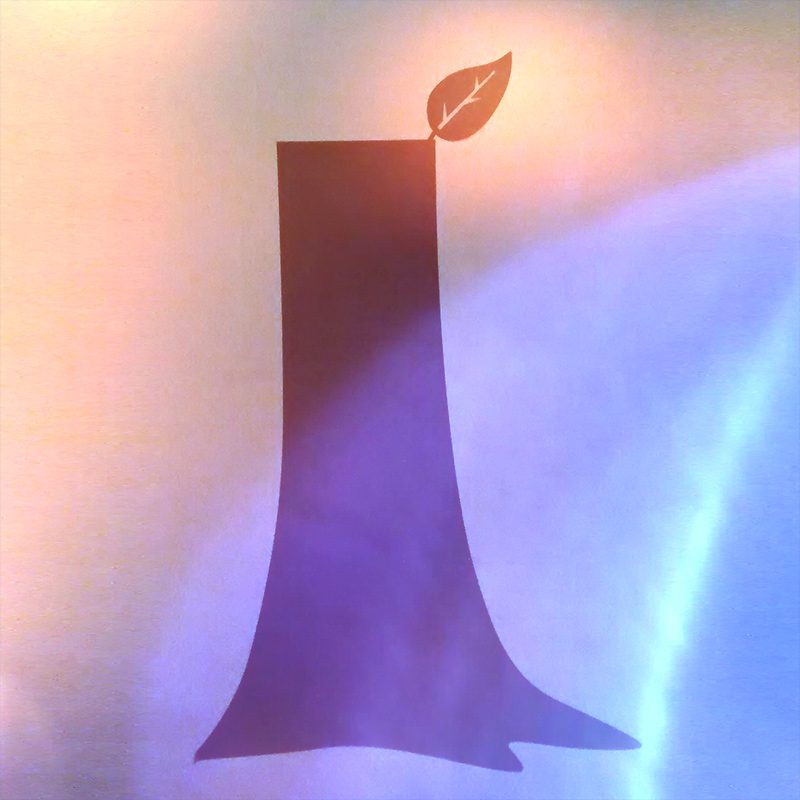
There was that tree on the wall. Both a plant and a time-stamped record. I had already taken down the photos a few weeks back, but the tree remained. I didn't want to kill it, I didn't think it was my right to kill it, but still, it was my last night there and it had to be taken down, with nobody else to do it. For most of my time living in that apartment I wanted to make something with that tree. An animation of some sort, I don't know. I never got around to do it. Taking it from the wall was my closest chance of doing so, and that's how I did. Slowly, revisiting each fruit that no longer hanged from the branches. Taking off each leaf at a time, handling each bird with care, leaving the main branches and trunk for last. Then, branches, as if the tree was growing, but in reverse, until there was only the roots and the base of the trunk, with a tiny leaf on top.

This was my way of not killing all the good we had together, but starting a new stage of our lives. Different from what it was, but that still requires caring and watering. I think this will be the last post on this subject. It was supposed to be before New Year, but since it's on my New Year streak, it counts as 2015.

Day-to-Day

Recovery.

January 11, 2016

The past two weeks felt more like two days. The whole process of moving is way more exhausting than the idea behind it. You think "pack, transport, unpack". Yeah, right. It took me ages to identify where each box should go, or what to do with the objects inside - not to mention the ones with mixed contents: spices from the kitchen, cleaning products, some photographic gear, cables and wires, one or two books and my shampoo. Then, after unpacking there's cleaning up - we took an entire week just to get rid of all the empty boxes and ended up dragging them in a very unsafe way across two or three major avenues to dump them at a supermarket - doing laundry, dishes, "what are we gonna do with all this bubble wrap??" and so forth. As I sort of mentioned in the previous post I decided to start 2016 fresh, so I hunted for a new phone, updated my notebook, fixed up a new desktop, disassembled a few other minor electronics and put them back together in working conditions - watch, flashlight, bike lights - and I think I finally finished it all.

In the meanwhile, my classes started, and I'm enjoying them. Being back in school actually feels very good. Gives me a sense of purpose, hard deadlines and makes me use my brain more, in less usual ways. Writing is something I like and it feels great to have the chance to go deeper into it - which also involves a lot of reading and practice. Posts should increase and diversify, but that's not a promise! Hahaha!

Back to the new house, we spent a good amount of time mapping nearby places - post office, grocery stores (various options within a 5 minute walk!), hardware stores, thrift shops, downtown Burnaby, drugstores. The closest thing to home is a liquor store, literally across the street from us. Then, Real Canadian Superstore, which is a very cheap and huge supermarket. The first time we went there - Nicko, Vinicius and I - we spent two hours walking around before settling on what we needed to buy and, even then, we forgot some food. We just didn't notice the time flying and we weren't having that much fun! Just kidding, it was pretty funny and we got to see incredibly large packages of food - one of Vinicius' favorite hobbies while grocery shopping here. I also found some exotic fruit which I haven't seen yet (guavas and carambolas - starfruit?!) and got mangoes and pineapples for a fraction of the regular price downtown. Life on the outskirts has its perks.

So far I've been biking to school, which is a 10km ride, with plenty of uphills,that takes me around 30 minutes. It's faster than taking the bus. The best part is coming back home which is mostly flat or downhill. The weather has been sunny lately but we're supposed to get some rain this week. Let's see how complex the ride gets.

This weekend was kind of a big celebration. Nati's birthday was last Thursday and Ariana's is today, so we mashed up birthday and housewarming parties on Friday. On Saturday we went to Metrotown for the sake of exploring - I had been there on Friday, facing what was probably my meanest uphill ever, on Rupert Street. Downtown Burnaby is so close to us it's almost scary ("am I no longer a resident of Vancouver?").

Everybody went to bed early because we rented a car for the weekend intending to go Whistler, the ski-paradise where everything is excessively expensive and there's snow all year round. Four brazilians in a winter paradise. No need to say we were freezing to death. I was stupid enough to think I would be able to photograph anything and packed a ton of gear which was rendered useless by trying to stay warm and tubing. (portuguese explanation for tubing: sabe esquibunda? Só que na neve, usando uma bóia daquelas de câmara de pneu de caminhão. É uma idéia estúpida de tão simples). On my first ride I thought I'd die. I was absolutely sure I would flip, break my neck, wreck the gear on my back, be thrown out of the mountain, all that at the same time, while going down a frozen hill at stupid speed. When I got to the bottom - which takes less than 30 seconds), I realized it's (nearly) impossible to die, so I ran up to the line again. I'm pretty sure we all got sunburned from all the snow.

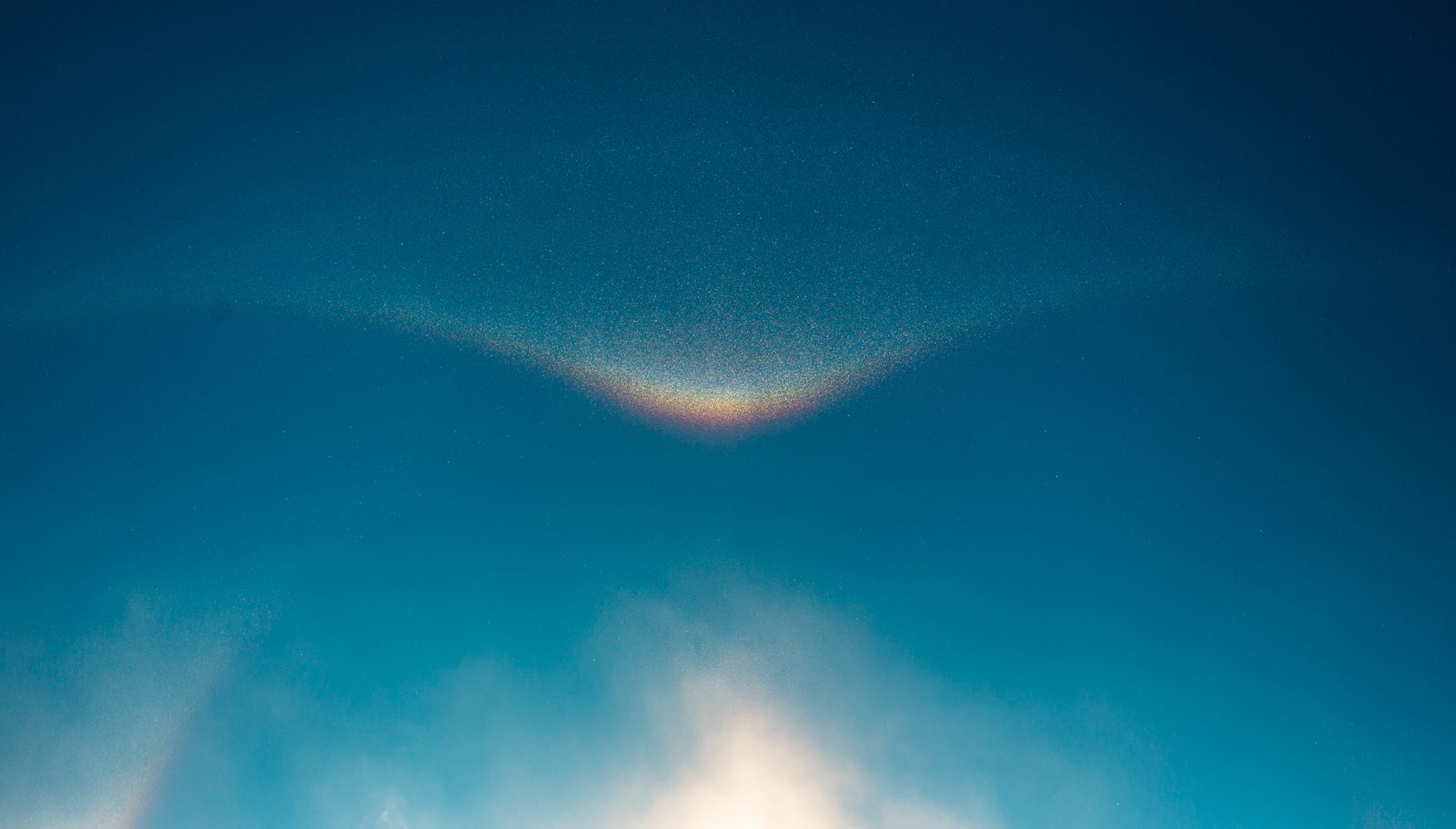
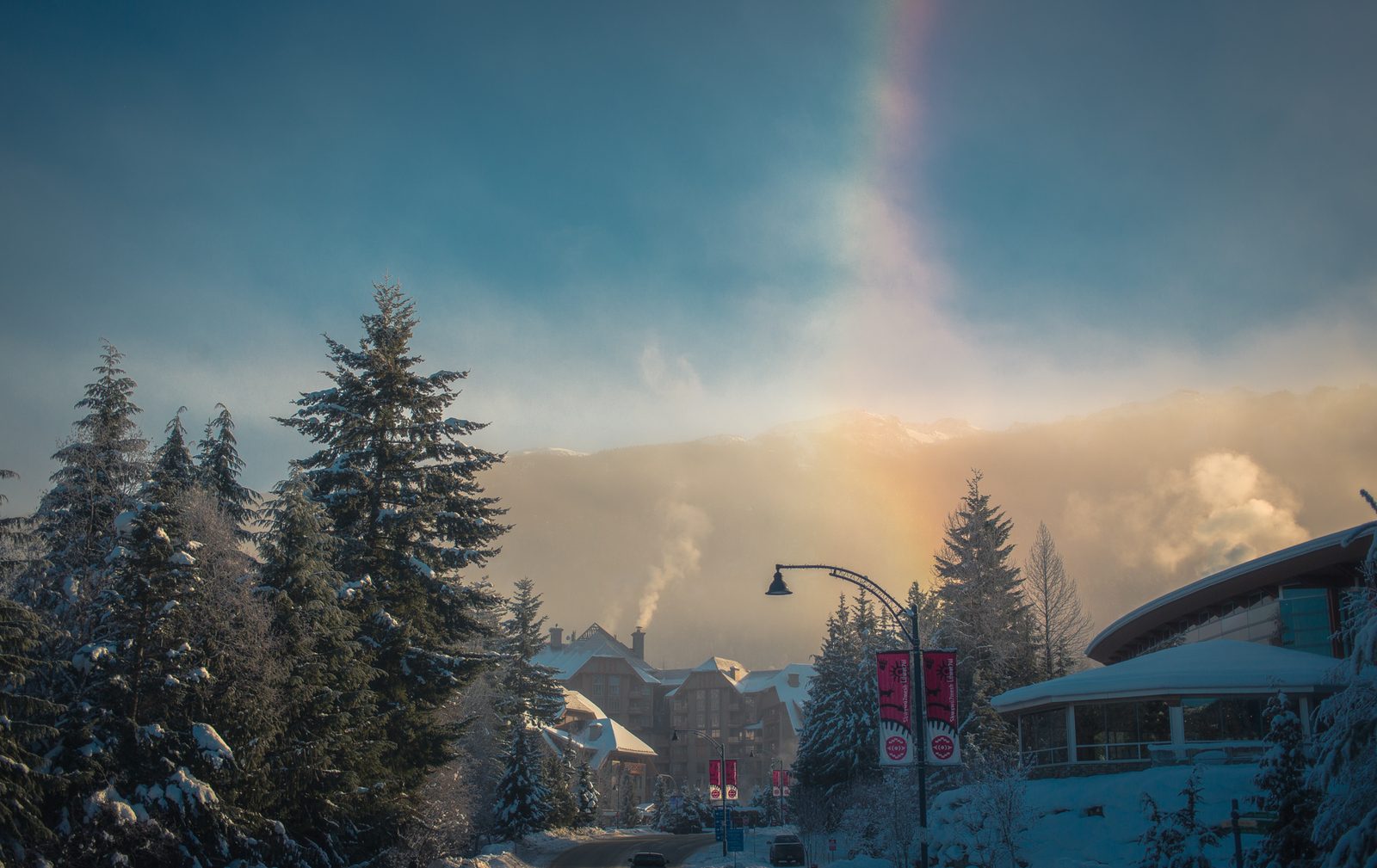
Oh, yeah, and when we got there we saw a triple-bending rainbow. Even though I had six lenses on me, none of them were wide enough to capture the full picture. Nati got this with her phone and I'm referencing it here too. Down below are two of mine, with very little post-processing. We were in the middle of a cloud, and I still haven't figured out the bent rainbow.

Triple rainbow #vancity #vancitybuzz #vancouver #explorebc #canada #nofilter

A photo posted by Natália Peixoto (@reinodanat) on


Snow and ice do an amazing job of twisting the light in - what are for me - weird and unexpected ways. My only real previous experience had been on top of Grouse mountain - a few weeks back. The weather was completely different yesterday, very enjoyable to observe. I think I might even be a little snow blind. Cool cool cool, at least it's not a cold, but my eyes hurt.